
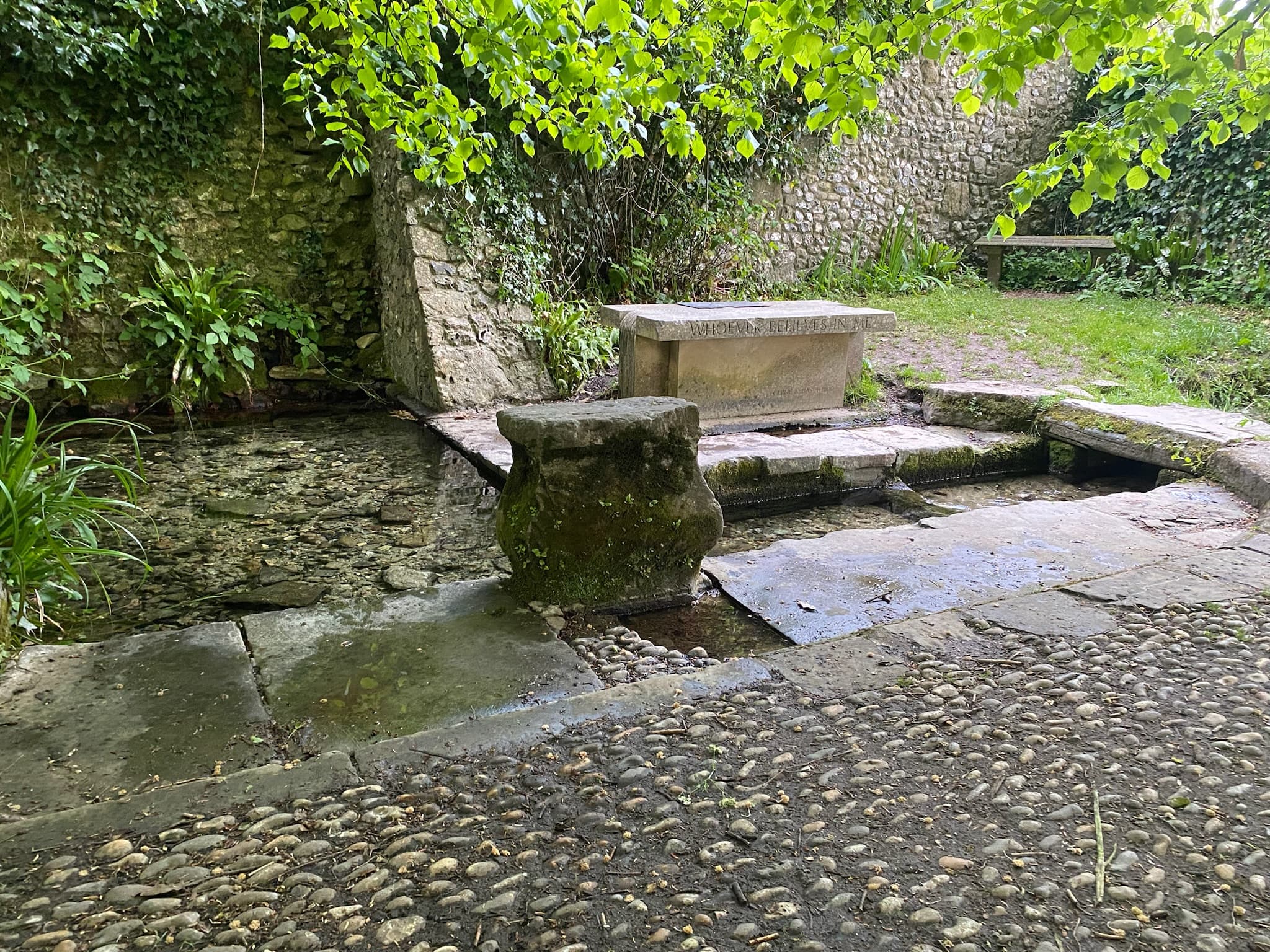
St Augustine's Well, Cerne Abbas
A holy spring on the edge of the churchyard at the top of Abbey Street, a short walk from Cerne Abbey and beneath the hill of the Cerne Abbas Giant. Also known as the Silver Well, its clear water has drawn pilgrims and seekers for over a thousand years.
It is a peaceful, free place to visit, set in a quiet, tree-lined hollow. The well is not part of the abbey or any paid visit, simply a sacred corner of the village that everyone is welcome to share.
A Place of Pilgrimage
The spring rises gently and runs clear into a shallow pool, then away through a stone-lined channel. It is a still, prayerful spot, shaded and softly green, where people have come to pause for many centuries.
The pool is ringed by lime trees known locally as the Twelve Apostles, and visitors still tie prayers and ribbons to the branches. Beside the waters stands a stone bench carved with a verse of scripture, placed to mark the millennium.
A chapel dedicated to St Augustine once stood over the spring. It was lost at the Dissolution of the monasteries in 1539, though the well it sheltered remains.
St Augustine's Miracle of the Well
In 597, St Augustine of Canterbury came to England to bring the Gospel to the English, sent by Pope Gregory the Great. Tradition tells that his mission carried him west into Dorset, where, in the valley below the hill, he came upon a group of shepherds.
He asked them whether they would rather drink water or beer. They chose water, and at this the saint gave thanks and struck the ground with his staff, and a clear spring rose up where there had been none. "Cerno El," he is said to have cried, "I perceive God", a play on Cernel, the old name of the village. The shepherds were baptised in the waters that had sprung up at his word.
It is a story held dear here for many centuries, a treasured tradition and a reminder of the faith that has drawn people to this spring for over a thousand years.
St Eadwold of Cerne
Older still, and better remembered here, is the story of St Eadwold of Cerne. Born around 835 and said to be a son of the royal house of East Anglia and a brother of St Edmund, King and Martyr, Eadwold gave up the comfort and standing of a prince to seek God in solitude. He left his homeland, perhaps in the troubled years of the Viking invasions, and came west to Dorset.
Following a vision of a silver well, he made his way to Cerne. He bought bread and water from a shepherd, whom he paid in silver, and knew the well at once as the one from his vision. He built his hermit's cell nearby and lived simply on bread and spring water, given to prayer and, it was said, to the working of many miracles, until his death around the year 900.
He was buried in his cell, and his memory drew pilgrims. In time his relics were brought into a monastery at Cerne dedicated to St Peter, not long before the abbey was founded in 987. So great was the devotion to him that his shrine is credited with making Cerne one of the richest abbeys in England by the eleventh century. His feast is kept on 29 August, and he remains the patron saint of Cerne.
Healing, Wishing and Prayer
Like many holy springs, the well gathered gentler customs over the years. It has long been thought of as a place of healing, its clear water said to soothe sore eyes, and newborn children were once brought to be dipped in it at sunrise.
Local women would come down to the well to ask St Catherine to intercede for them, praying that God might send a good and faithful husband. St Catherine of Alexandria, an early Christian martyr and the patron saint of women hoping to marry, was a much-loved figure in medieval England, and an eroded carving of her wheel can still be seen on one of the stones beside the pool. The asking was of her prayers, offered to God on their behalf, in the way the faithful have long sought the prayers of the saints.
Visiting the Well
The well is free and open, and reached on foot from Abbey Street. From the parish church of St Mary's, walk north towards the hill, past the grand house and the duck pond, and through the gate into the churchyard on the right. Follow the path down and you will reach the well in a minute or so.
It lies roughly 100 metres from Cerne Abbey and a short walk from the Cerne Abbas Giant. It is not a ticketed attraction and is not run by the abbey, so please treat it as the quiet, sacred place it is.
Combine the Well With a Visit to the Abbey
Many who come to the well also make time for the abbey close by. You can plan your visit to Cerne Abbey, and the well can be included on a private tour by arrangement.